
How to Search Criminal Dockets
Start with the court that filed the case. Pierce County Superior Court felony matters and Pierce County District Court misdemeanor, gross-misdemeanor, and criminal-traffic matters can be searched in LINX. Select Criminal under the correct court level. A Superior cause number may appear as 02-1-12345-1, though a party-name search is also available. The statewide Washington Courts service can search municipal, district, superior, and appellate cases when the local court is uncertain.
Use the name as the clerk indexed it, or use the cause number from a notice or order. Then compare the court, case type, and filing date before treating a result as the right case. The statewide system warns that identity matches, status, and document links may be incomplete. The court file remains controlling.
- Choose Superior or District Court in LINX, or select the right court level in Washington Courts.
- Enter the cause number, or enter the indexed last and first name plus a useful year range.
- Select Criminal and open only a result whose court and case details match the papers.
- Read charges, settings, pleas, orders, and disposition as separate docket events.
- Ask the responsible clerk for a public document or certified copy when the index is not enough.
Pierce Criminal Search in LINX
LINX separates Superior and District searches. Both offer cause-number and name fields, year controls, and a Criminal checkbox. District Criminal includes misdemeanors and gross misdemeanors, including criminal traffic. That category is distinct from the District Infraction checkbox. Superior criminal results may list counsel, charges, proceedings, and judgments.
The official Pierce County LINX search screen shows why selecting the court and case type matters.
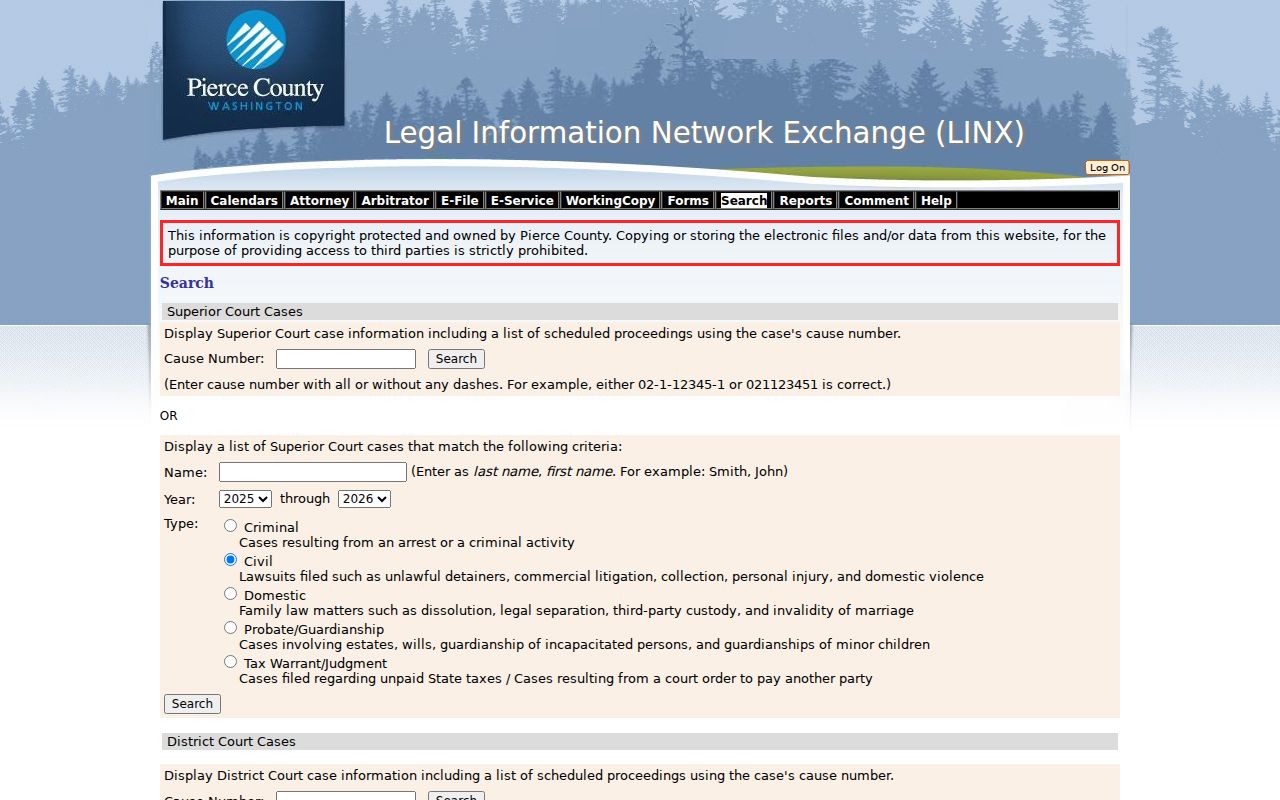
The separate controls keep a Pierce County Superior felony search from being confused with a District criminal-traffic search.
What a Criminal Docket Shows
A Pierce County criminal docket is an event index, not a single narrative. Its header may identify the court, cause number, filing date, status, judicial department, and next hearing. Party fields label the State or city, defendant, counsel, and prosecutor roles. Charge rows may state the count, statute or ordinance, description, degree, and amendment status. Event rows can mark a complaint, warrant action, plea, continuance, order, judgment, or appeal. A document icon may provide a public image, but some entries show only that a filing occurred.
| Cause number | The local identifier, such as 02-1-12345-1, used for a precise search. |
|---|---|
| Charges | Count, description, statute or ordinance, class, and any amended-charge marker. |
| Settings | Arraignment, pretrial, readiness, trial, sentencing, review, date, time, and department. |
| Documents | Complaint, orders, judgment and sentence, notices, and public image availability. |
| Disposition | The exact court term, date, and linked order when one is publicly available. |
Read Pierce Dispositions Exactly
A docket entry must not be stretched past its words. A filed charge is an allegation. It is not a finding. Likewise, dismissed, deferred, vacated, sealed, and acquitted describe different events. A vacated adult record may still leave a public index showing the case number, type, name, and “vacated.” A dismissal does not mean the file was sealed.
- Dismissed
- The court ended a charge or case without a conviction on that count.
- Deferred
- Final action was postponed under stated court terms; read the later entry for the result.
- Vacated
- A prior judgment received court-ordered relief, which does not always erase the index.
- Sealed
- Public access is limited by a court order under the governing rule.
Stages on a Criminal Docket
A Pierce County criminal case usually begins with a complaint or information and an assignment. Arraignment records the initial appearance and plea. Pretrial and readiness entries deal with preparation, motions, discovery, and scheduling. A case may then resolve by plea, dismissal, or trial. The docket later records judgment, sentence, review, appeal, or post-judgment action when applicable. Not every case follows each stage, and a reset may produce several settings before any disposition.
Docket flow: Filing › Arraignment › Pretrial › Plea or Trial › Disposition › Sentencing
Pierce Calendars Refresh in Cycles
LINX publishes criminal calendars that include anticipated trial dates, readiness matters, and in-custody arraignments. Pierce County help material says calendars are regenerated about every two hours. That is an update cycle, not a promise that a listed hearing will remain unchanged. New case information is normally entered in about four hours and may take up to 24 hours after filing.
If a filing or setting is missing, check again, then call the clerk for the court shown on the papers. Superior Court and District Court maintain separate records desks. A municipal prosecution belongs with the city court that filed it. Do not infer dismissal from a blank or delayed online result.
Which Court Holds Criminal Dockets
Pierce County Superior Court holds felony dockets and other criminal matters within its general jurisdiction. Pierce County District Court handles misdemeanors, gross misdemeanors, and criminal traffic within its limited jurisdiction. Municipal courts hear city-code offenses and qualifying misdemeanor or traffic matters. Tacoma, Lakewood, Puyallup, Bonney Lake, Gig Harbor, Fife, and other local courts have their own filing routes, while some communities contract with another court.
Ask which government filed the charge before searching. Superior Court case files are kept by the Pierce County Clerk. District Court cannot provide Superior or Juvenile Court records. City matters should be requested from the named municipal court, and federal criminal cases at the Western District of Washington use PACER and CM/ECF rather than LINX.
Pierce Criminal Filings by Number
The Washington Courts 2025 annual filings table reports 3,721 Pierce County Superior criminal filings. That total includes non-charge matters under the report’s notes. It does not measure unique people, convictions, or completed cases. Pierce data comes from LINX, while parts of statewide JIS, trial, or non-trial reporting may be incomplete.
The count shows the scale of clerk and court activity. It cannot answer what happened in any one prosecution.
Pierce Criminal Clerk Channels
Superior case copies are available from the Pierce County Clerk in Room 110, through a LINX case page, or by mail. Call (253) 798-7455 for pre-1991 files or an exact mailed-request amount. District records have their own request page, counter, and phone line at (253) 798-7487. A caller should provide the name, date of birth, cause number if known, incident date when relevant, exact documents, urgency, and preferred delivery method.
Phone contact can confirm routing and current status, but the filed record remains the source. Mail requests for Superior files require the identifying details, a self-addressed stamped envelope, and the clerk-approved advance payment. Personal checks are not accepted for the listed Clerk transactions.
Pierce Criminal Index Versus Order
A LINX event line can show that a judgment, warrant action, continuance, or sentencing order was entered. It may not show the order’s full terms. When a public image is available, open it and confirm the cause number, entry date, and court. If no image appears, request the public filing from the correct clerk.
This distinction matters most when the exact result controls. A status label can lag, and a hearing entry may state only that an event was scheduled. The signed order, judgment and sentence, or dismissal document gives the precise court action.
Pierce Juvenile Criminal Privacy
Pierce LINX excludes juvenile-offender information from its public website. Remann Hall and its Juvenile Court clerk are the proper contacts for an authorized request. RCW 13.50.050 governs juvenile offender and related information, while RCW 13.50.100 protects juvenile non-offender records.
An adult docket may mention a related matter without making the juvenile file public. Do not infer a child’s identity or case facts from that cross-reference. Record only the public label and the access restriction.
Pierce Criminal Portal Changes
Pierce County began a District Court LINX e-filing soft launch on August 10, 2026. The first stage covers no-fee filings, selected document types, free self-represented accounts, attorney subscriptions, and email acceptance or rejection notices. Traditional filing remains available while the integration grows.
A missing District document may reflect rollout limits rather than a failure to file. Check the docket, confirmation email if it is your filing, and District Court directly. Portal names and document coverage may change during Washington’s broader limited-jurisdiction modernization.
Public Access and Sealed Criminal Dockets
Washington General Rule 31 starts with public access to court records, subject to state law, other court rules, case law, and court orders. Public access may include an unsealed index, docket entries, orders, and judgments. Online coverage can be narrower than the clerk’s file. At the courthouse, a person may usually inspect a public record without a copy charge, then request a plain or certified copy if needed.
LINX does not show confidential cases or juvenile-offender information on its public site. Juvenile access is governed in part by RCW 13.50.050 and RCW 13.50.100, with the Juvenile Court clerk at Remann Hall handling the proper route. For a sealed adult matter, preserve the public label and seek review through the court. Never rebuild a restricted field from another source.
Key rules:
Washington General Rule 31 governs public access to court case records and permitted restrictions.
Washington General Rule 15 governs sealing and redaction by court order.
RCW 13.50.050 sets special rules for juvenile offender and related information.